Technical article
Endress+Hauser Prowirl 200 vs. Mass Flowmeter: What Ordering 60 Flow Meters Taught Me
by Jane Smith
An office administrator compares Endress+Hauser's Prowirl 200 and mass flowmeter offerings from a procurement perspective—covering accuracy, maintenance, and total cost of ownership—with practical buying advice for engineers and purchasing teams.
I've been managing equipment purchasing for our manufacturing plant for about five years now. That means I order everything from micrometer heads for the machine shop to Research Plus pipettes for the quality lab. But the category that took me the longest to understand? Process flow meters. Specifically, the times I've had to choose between the Endress+Hauser Prowirl 200 flow meter and an Endress+Hauser mass flowmeter for the same application.
When I first took over purchasing in 2020, I assumed "precision" meant the same thing across all instruments. It does not. A micrometer head and a Coriolis mass flowmeter both measure physical quantities, but the comparison ends there. Different principles. Different maintenance profiles. Very different price tags.
The Comparison Framework
When our engineers ask for a flow meter, they're usually weighing two Endress+Hauser technologies:
- The Endress+Hauser Prowirl 200 — a vortex flow meter that's become a workhorse for steam, gas, and general utility service.
- The Endress+Hauser mass flowmeter — a Coriolis-type device that measures mass flow directly through vibrating tubes.
The measurement principle is the obvious difference. The non-obvious ones—accuracy needed, maintenance burden, total cost—are where purchasing decisions actually get made. I'll walk through each.
Dimension 1: Accuracy and Measurement Principle
This is the dimension everyone expects, so let's get it out of the way.
The Endress+Hauser mass flowmeter is more accurate. Mass flow is measured directly, no temperature or pressure compensation needed. Per Endress+Hauser's published specifications, their Coriolis devices land around ±0.1% of rate, depending on model and application. That's genuinely impressive.
The Prowirl 200 measures vortex frequency and correlates that to volumetric flow. It's accurate, but at a different level—roughly ±0.75% to ±1.5%, depending on the fluid and whether you add temperature and pressure compensation for mass flow inference.
Here's what surprised me after about three years and maybe 150 orders total: most applications don't need Coriolis-level accuracy. Of the roughly 60 flow meter orders I've processed, I'd estimate only 10% were for applications where the difference between ±0.1% and ±1% actually changed the process outcome. Custody transfer? Absolutely. Precise chemical dosing? Yes. But for steam monitoring, cooling water, most utility lines? The vortex meter's accuracy is more than sufficient.
So on paper, the mass flowmeter wins. In practice, the Prowirl 200 is often the smarter choice.
Dimension 2: Reliability and Maintenance
Neither meter has moving parts in the conventional sense. But they wear differently.
The Prowirl 200 is the simpler device—a bluff body, a piezoelectric sensor, no flow tubes to coat, no vibration to sustain. It handles dirty fluids better and produces a lower pressure drop, which our plant engineers care about more than I initially realized.
The Coriolis meter is also reliable, but its vibrating tubes can be affected by erosion or coating buildup over time. In certain applications, that affects accuracy. And when it does, the fix is often a factory calibration cycle—which means downtime and shipping heavy hardware both ways.
We've had fewer call-outs on the vortex meters. Our lead instrument tech would back that up; the Prowirl's self-diagnostics have caught issues before the process was even affected. I can't guarantee your experience will match, but our maintenance records are consistent.
This connects to something I've become annoying about internally: verifying before ordering. The 12-point checklist I created after my third purchasing mistake—I ordered the wrong process connection, if I remember correctly—has saved us an estimated $8,000 in potential rework. Five minutes of verification beats five days of correction.
Dimension 3: Total Cost of Ownership
Purchase price first: the Coriolis mass flowmeter costs roughly double the Prowirl 200 for comparable line sizes. Maybe 1.5x to 2.5x depending on options—I'd have to check the last few quotes, but that's the ballpark.
Then calibration. Coriolis meters need factory calibration to maintain their accuracy spec. That's a recurring cost, both in money and downtime. Vortex meters also get calibrated, but the simpler technology and wider tolerance make field verification more practical.
Spare parts, installation (the mass flowmeter is noticeably heavier), and operator training all add up. Then there's the cost of a failure. At our plant, downtime runs somewhere between $500 and $1,000 an hour depending on the line.
For a recent project, I calculated the worst case: mass flowmeter failure requiring a factory calibration cycle—roughly $4,500 in repair, shipping, and lost production. The upside was higher accuracy on a line that didn't strictly need it. The expected value said go with the Prowirl 200, but the downside felt catastrophic until I actually sat down with the numbers. We went with the vortex meter, and I don't regret it.
The same logic applies to other precision tools we buy. We purchase genuine Research Plus pipettes for the lab because cheaper pipettes cause enough variation to waste hours of troubleshooting. For the machine shop, though, our standard micrometer heads serve fine—we don't need laboratory-grade calibration certificates for general shop work. It's the same principle at different scales: buy precision where the process needs it, not where the spec sheet looks impressive.
Documentation and Support: The Hidden Dimension
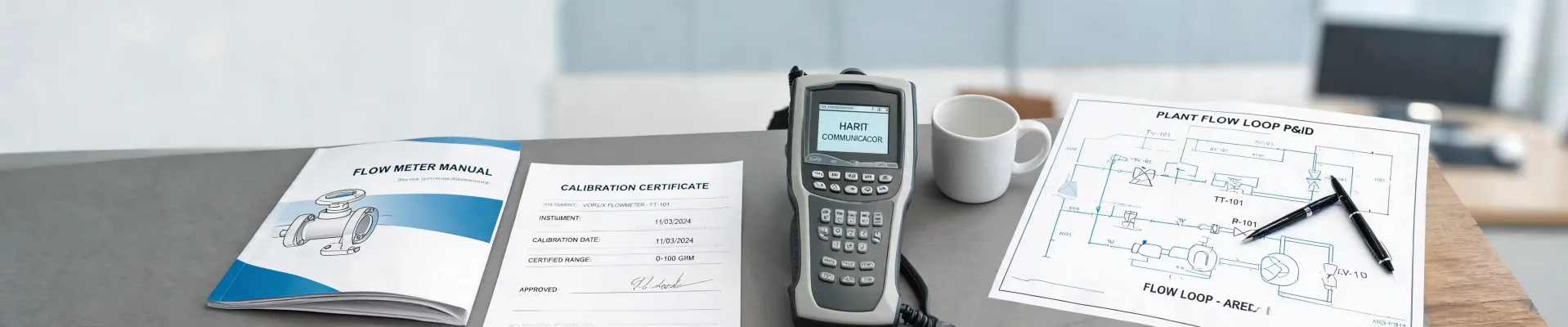
Nobody puts "documentation quality" on a flow meter comparison matrix. But from my side of the desk, it's a major factor. When I place an order, I need the manual, the wiring diagram, the calibration certificate, and clear spare parts guidance to be useful for years, not just at startup.
Both Endress+Hauser meters ship with well-organized documentation. I've used the digital tools more than I expected—the configuration software, the diagnostic guides. The Prowirl 200's documentation is a bit more straightforward, while the Coriolis meter manuals go deeper into setup parameters. Both are solid, but simpler devices have simpler documentation.
This carries over to other instruments. When our maintenance team asked me to evaluate Klein vs Fluke multimeters, I looked at the same thing: documentation, calibration support, long-term availability of accessories. Fluke's consistency there is a big part of why they're the default in our plant—though honestly, Klein's meters are solid for the money. If the team doesn't need top-tier accuracy, Klein holds up fine. It depends on the use case, and I don't think one brand is universally better.
This dimension also matters for compliance. We're not doing fiscal metering, but we do have clients who audit our quality processes. Being able to pull up traceable calibration documentation goes a long way in a client audit.
What I'd Recommend
Here's the practical takeaway, from someone who signs the purchase orders rather than calibrating the devices:
Choose the Prowirl 200 if:
- You're measuring steam, gases, or general liquids within the meter's range.
- The process doesn't require mass flow accuracy below ±0.5%.
- You want a lower purchase price, simpler maintenance, and minimal spare parts inventory.
- Your maintenance team has limited experience with Coriolis technology.
Choose the Coriolis mass flowmeter if:
- Fluid composition varies—volumetric measurement alone won't be reliable.
- You need mass balance, precise dosing, or custody transfer levels of accuracy.
- You can justify the higher initial cost and the calibration cycle over the meter's lifetime.
And one more piece of advice: ask the engineers what the meter data is actually used for before you place the order. If the reading goes into a control loop or a compliance report, you'll want the higher accuracy. If it's for monitoring and trending, a well-applied vortex meter will do the job at a fraction of the cost.
After five years of managing these purchases, I've come to believe that the best precision instrument is the one that's good enough, serviceable, and supported. For our plant, that's meant choosing Endress+Hauser most of the time—but choosing the Prowirl 200 more often than our engineers initially requested.

Jane Smith
I’m Jane Smith, a senior content writer with over 15 years of experience in the packaging and printing industry. I specialize in writing about the latest trends, technologies, and best practices in packaging design, sustainability, and printing techniques. My goal is to help businesses understand complex printing processes and design solutions that enhance both product packaging and brand visibility.