Technical article
Endress+Hauser Flow Meter Calibration: I Learned This the $890 Way
by Marcus Feld
A process instrumentation technician shares hard-won lessons about Endress+Hauser flow meter calibration, radar level transmitters, and when a $400 rush fee is worth it.
-
The $890 flow meter calibration mistake that started it
-
Why calibration planning is a financial issue, not a paperwork issue
-
Radar level transmitter Endress Hauser: the mistake wasn't the instrument
-
Handheld moisture meters: the MR176 has a specific job
-
The honest answer to 'how to use extech moisture meter'
-
What the Fluke 115 multimeter can and can't tell you
-
A $400 rush fee that was worth it
-
Boundary conditions: when the above doesn't apply
If you're about to buy an Endress+Hauser flow meter and you haven't planned for calibration, stop. You're not saving money; you're deferring a $300–$1,200 bill that eventually lands with interest. I've paid that bill, and then watched the delay cost more than the calibration itself. A calibration plan isn't the boring part of a purchase. It's the part that keeps a bad number from becoming a shutdown.
I'm a process instrumentation technician. I've been handling Endress-Hauser orders and other process instrumentation for 12 years. I've personally made and documented 14 significant mistakes, totaling roughly $23,000 in wasted budget. This is the checklist I wish someone had handed me on day one.
- Plan traceable calibration before you order the instrument. Don't wait for the auditor to ask.
- Check tank geometry, nozzle size, and mounting location before you choose a radar level transmitter. The quote won't show you a false echo.
- Use handheld moisture meters as screening tools, not process proof. A spot check is a sample, not a trend.
- When a deadline matters, pay for a fixed commitment. A rush fee buys certainty, not just speed.
The $890 flow meter calibration mistake that started it
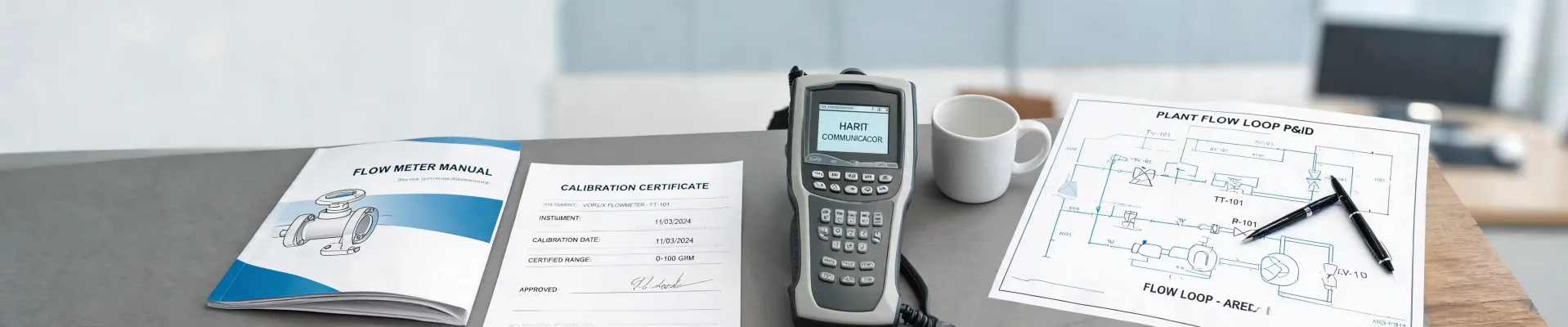
In February 2018, I ordered a Promass flow meter for a food-grade line. I approved the quote, arranged the delivery date, and didn't confirm what the calibration certificate actually covered. The instrument arrived, and the customer's validation team rejected the paperwork because it didn't meet their traceability requirements. We sent the meter to an ISO/IEC 17025-accredited lab, paid for a recalibration, and waited one week. The recalibration cost $890. The delay cost more.
Why calibration planning is a financial issue, not a paperwork issue
Most buyers focus on the price of the transmitter and completely miss setup fees, installation labor, configuration time, and calibration planning. In my experience, those extras can add 30% to 50% to the first-year cost. That's not an argument against buying quality instrumentation. It's an argument for budgeting for the whole system.
If your CMMS has a task called 'Endress Hauser flow meter calibration' due every 12 months, put it in the system when the meter arrives, not when someone asks for the certificate. According to ISO/IEC 17025:2017, calibration results should be traceable to national or international standards. That means the certificate should state the reference standard, the measurement uncertainty, and the environmental conditions. If a vendor gives you a 'calibration' without that context, ask tougher questions.
Radar level transmitter Endress Hauser: the mistake wasn't the instrument
In September 2022, I supervised the installation of an Endress+Hauser radar level transmitter in a stirred storage tank. I checked the 4–20 mA wiring, the HART address, and the supply voltage. I didn't check the nozzle height or the position of the agitator blades. At low level, the radar locked onto a false echo. When the agitator moved, the reading jumped by almost a foot.
The transmitter was fine. The installation was wrong. After we moved the antenna into a stilling well and restarted the empty spectrum mapping, the measurement became stable. The FMR62 we used is a good instrument; it was placed poorly. The lesson: 'radar level transmitter Endress Hauser' is the easy part of the search. The hard part is matching the antenna and mounting location to the tank. According to Endress+Hauser's online selection guidance (endress.com), nozzle size, dielectric constant, and process conditions all affect the best mounting arrangement.
Handheld moisture meters: the MR176 has a specific job
Not every moisture measurement needs a HART link. For incoming raw material, the Sinar MR176 moisture meter is still a favorite in our lab. The MR176 moisture meter gives a fast, repeatable spot reading, and it's easy to train people on. But it's a manual tool. It doesn't give you a continuous process signal, and it doesn't tell you what happens between readings.
I learned that the hard way when a project engineer asked for continuous moisture monitoring and I suggested a handheld. He didn't want a sample from ten minutes ago. He wanted a live value for the operator. The MR176 is a fine tool when you use it as a tool, not as a substitute for an inline analyzer.
The honest answer to 'how to use extech moisture meter'
The question I hear most often is 'how to use extech moisture meter' for building checks, wall leaks, or floor surveys. The practical answer: start with the pinless scan mode to find suspicious areas, then confirm the spot with the pin probes. An Extech moisture meter is a screening device. It helps you decide where to cut a sample or install a monitoring system. It is not a certified reference for product quality.
What the Fluke 115 multimeter can and can't tell you
I carry a Fluke 115 true-rms multimeter almost every day. The 115 multimeter is great for checking loop current, verifying 24 V supplies, and tracing wiring faults. But it can't check a Coriolis meter's zero point, and it can't interpret a radar echo curve. I've seen technicians chase a bad transmitter for half a day because they had good power and a clean 4–20 mA reading. The power was fine. The sensor's internal validation was not. Use the multimeter to confirm the electrical layer, then use the instrument's own diagnostics for the measurement layer.
A $400 rush fee that was worth it
In March 2024, one of our Endress-Hauser flow meters drifted right before a scheduled production run. The plant chose between a 5-day standard calibration at $485 and a 24-hour rush calibration at $885. The production line was worth roughly $3,500 per hour, so the decision wasn't hard. We paid the rush fee, the instrument came back with a certificate in 20 hours, and the crew was ready when it arrived.
That $400 extra didn't buy speed. It bought a fixed commitment. If you've ever been told 'probably Tuesday' when your line is down, you know the difference. A rush fee means nothing unless the lab commits to a date in writing. The commitment is the product.
Later, when I compared rush and standard calibration work side by side over a full year, I realized the real difference wasn't lab speed. It was planning. The instruments on a routine schedule never needed a panic call. The panic calls were almost always caused by late decisions on our side. The 40% premium was the fine for our own delay.
Boundary conditions: when the above doesn't apply
Not every instrument needs an annual calibration. A local temperature display used for a rough heating check doesn't need the same traceability as a custody-transfer flow meter. A radar level transmitter used for a high-level alarm can sometimes be verified with a simple echo check instead of a full recalibration. The goal isn't to spend more; it's to know which measurements are safety-relevant, billing-relevant, or quality-relevant, and to plan accordingly.
Some vendors include traceable calibration in the original purchase price. Ask for the exact scope in writing. If they don't include it, budget for it. If they do, keep that certificate in a safe place with the instrument's serial number and commissioning date.
Calibration pricing as of January 2025; verify current rates with your local Endress-Hauser service representative.

Marcus Feld
Marcus Feld is an electrical test and measurement analyst specializing in multimeters, oscilloscopes, clamp meters, insulation testers, spectrum analyzers, and data loggers. He applies IEC 61010-2-030 and IEC 61010-031 concepts while examining measurement category, bandwidth, true-RMS response, input loading, and stated uncertainty. His work helps maintenance engineers and test teams choose safe instruments with performance suited to the signals and environments they actually measure.