Technical article
Why I Now Buy Coriolis Flow Meters from Endress+Hauser (A $14,000 Procurement Lesson)
by Marcus Feld
A procurement administrator explains how a cheap compatible flow transmitter led to $14,000 in rework—and why they now use a checklist for Coriolis flow meters, Bluetooth multimeters, and photoelectric sensor durability.
On a Tuesday morning in March 2023, I got an email that made me put down my coffee. The customer's batch skid was reading 30% low on product flow. They had already shipped the batch. By Friday, we had spent $14,000 on rework and a site visit. And the root cause was a $400 decision I had approved.
I'm not an engineer. I'm the office administrator for a 120-person industrial automation company. I process about 60-80 order lines a year across 8 vendors—roughly $800k in annual spend. I report to both operations and finance. I don't choose technical specs; I turn requisitions into purchase orders. But after that March, I started questioning every “deal” that crossed my desk.
The $400 decision: a Coriolis flow meter from Endress+Hauser
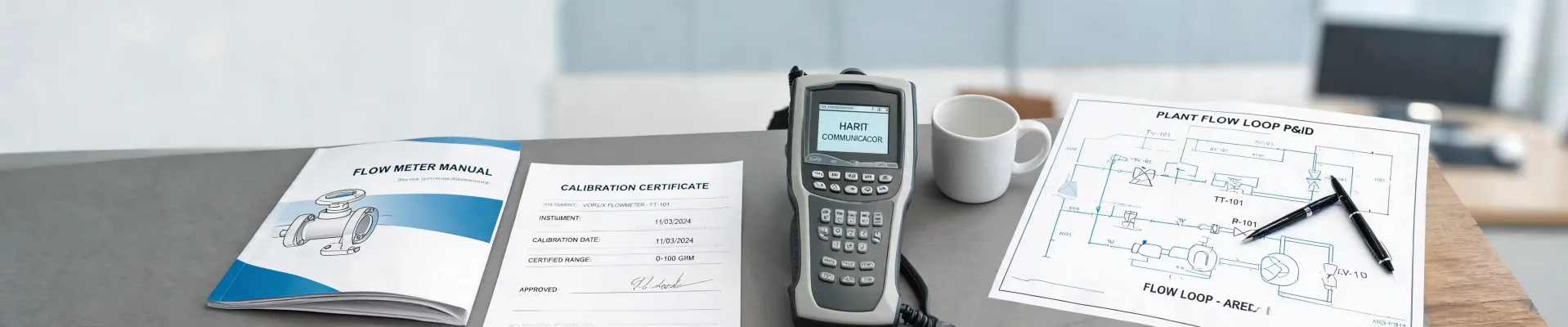
The original spec on that skid called for a Coriolis flow meter that Endress+Hauser had supplied years earlier—a Proline Promass model. It had been running for years. When the transmitter failed, our maintenance lead sent me a quote for a replacement: about $4,100.
Then a new supplier called. They offered a “compatible” transmitter for about 15% less. Same connector, same 4-20 mA output, same HART protocol. The maintenance lead didn't love it, but he was under pressure to get the skid running, and I was under pressure from finance to watch the budget. So we bought the cheaper one.
At first, it worked. The display came on. The readings looked normal. I marked the invoice paid and didn't think about it again.
Two months later, the customer's PLC started showing erratic mass flow readings. Our technician checked the wiring. Fine. Checked the sensor. Fine. Then he connected to the transmitter and saw the real issue: the calibration data didn't match the sensor. The compatible transmitter was basically running with the wrong personality. It was measuring something, just not the right thing.
Everything I'd read about compatible process instruments said they're fine as long as electrical specs match. In practice, for a Coriolis flow meter, Endress+Hauser's sensor and transmitter work as a matched pair. Per Endress+Hauser's technical documentation, the transmitter reads calibration data from the sensor's built-in data module. What I mean by “calibration data” isn't just a trim adjustment. It's a set of factory coefficients. Without them, the transmitter has to guess. A generic replacement can still send a signal. But outputting a signal isn't measuring.
By the end of the week, we ordered the correct Endress+Hauser flow transmitter, paid for expedited shipping, and sent a technician back to the site. Total cost: $14,000.
We saved about $400. The “compatible” transmitter ended up costing us almost $14,000. A lesson learned the hard way.
That's when my purchasing checklist expanded
If you've ever approved a purchase order based on price alone, you know the feeling. You think you're being responsible. Then the real cost appears somewhere else.
I assumed “same specifications” meant identical results across vendors. Didn't verify. Turned out each vendor had a slightly different interpretation of what “compatible” meant.
When I took over purchasing in 2020, I thought my job was to keep costs down. Now I know the most expensive part is often the second visit.
A Bluetooth multimeter taught me the same lesson
In early 2024, our fleet maintenance shop asked for multimeters for automotive diagnostics. I found a cheap model for about $45 each and ordered five. They worked for basic voltage checks. Then the lead technician asked if they could log readings while the engine was running. They couldn't.
We returned four of them and bought a Bluetooth multimeter instead. It cost about three times as much, but it streams live readings to a phone. For multimeter automotive work, that logging feature was the deciding factor.
Some people would call Bluetooth a nice extra. Honestly, it was the whole reason for the purchase. We weren't buying a display. We were buying the ability to catch an intermittent problem before the truck left the shop. That's prevention, not luxury.
The durability of ifm photoelectric sensors vs others
The same principle came up on the packaging line. We were replacing photoelectric sensors on a washdown conveyor. The standard option was about $80. The maintenance engineer suggested an ifm sensor that cost around 60% more.
The question wasn't whether ifm was “better” in every spec. It was whether the durability of ifm photoelectric sensors vs others justified the premium in that environment.
I can't give you a lab report. I can give you our maintenance log: from May 2024 to January 2025, the ifm sensors had zero failures. The previous budget sensors failed three times in six months, mostly because moisture got inside. The ifm datasheet listed IP69K and explained the test method. The cheaper sensor's IP rating was lower and buried in a footnote.
We made the switch. No rework since.
I'm not saying buy premium every time. Sometimes the cheap one is fine. But when the equipment is hard to reach, or the process can't tolerate downtime, durability wins quickly.
The checklist I use now for every instrumentation order
Here's the system that came out of that March mess. It applies to process instruments, test tools, and sensors:
- Match the electronics to the sensor, not just the connector. If the part number doesn't trace back to the original manufacturer's calibration data, it's not a true replacement.
- Get the serial number from the current sensor before ordering a transmitter. The transmitter needs that data to work correctly.
- Ask the vendor directly: Does this transmitter accept the sensor-specific calibration data? If they can't answer clearly, walk away.
- Compare total cost, not line item price. Include downtime, travel, and the chance of a second site visit.
- For sensors in harsh environments, check the IP rating and the test method behind it.
That last point sounds obvious, but I learned it from watching a $400 savings turn into a $14,000 invoice.
The cheapest quote isn't the cheapest order. It's just the cheapest signal.
One year later
As of January 2025, those skids have had no repeat transmitter failures. We standardized on Endress+Hauser for flow. The automotive shop has the Bluetooth multimeter it needed. The packaging line runs with ifm sensors.
I still don't enjoy spending extra money. But I now know that five minutes of verification beats five days of correction. Trust me on this one. I've got the invoices to prove it.

Marcus Feld
Marcus Feld is an electrical test and measurement analyst specializing in multimeters, oscilloscopes, clamp meters, insulation testers, spectrum analyzers, and data loggers. He applies IEC 61010-2-030 and IEC 61010-031 concepts while examining measurement category, bandwidth, true-RMS response, input loading, and stated uncertainty. His work helps maintenance engineers and test teams choose safe instruments with performance suited to the signals and environments they actually measure.