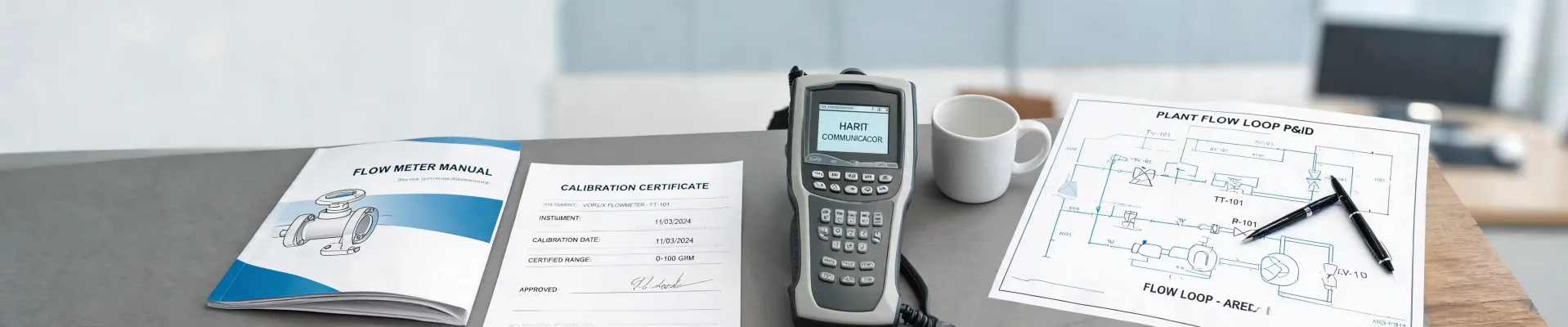
Technical article
The $3,800 Quote That Taught Me to Stop Comparing Prices and Start Comparing Costs
by Marcus Feld
An office buyer's story about a 2024 vendor consolidation, an Endress+Hauser radar level transmitter, and why total cost of ownership matters more than the unit price.
I Almost Signed a $3,800 Mistake
The day I almost approved a $3,800 saving was not dramatic. It was a Tuesday in April 2024, and I had three quotes on my screen for an Endress+Hauser radar level transmitter. The lowest one was 18% below the next one. I remember thinking, this is the kind of win my VP wants to see.
I'm the office administrator for a 400-person industrial services company with three locations. I manage 60–80 orders a year across about eight vendors—roughly $250,000 in annual purchasing. I report to both operations and finance. This story isn't a heroic engineering rescue. It's about spreadsheets, and why the numbers in them are not the real cost.
The 2020 Invoice That Changed How I Buy
When I took over purchasing in 2020, I was a price shopper. I once found a new vendor selling temperature probes for 30% less than our regular supplier. I knew I should ask for a sample invoice before ordering, but I thought, “What are the odds?” Well, the odds caught up with me. I ordered 40 units. They couldn't provide a proper invoice—handwritten receipt only. Finance rejected the expense report. I ate $1,800 out of the department budget. Now I verify invoicing capability before placing any order.
If I had only added the hours I spent chasing that invoice, the “cheap” probes cost more than the original supplier's price.
That was my first lesson in total cost of ownership, though I didn't have the name for it then.
The 2024 Vendor Consolidation
In 2024, we consolidated vendors across our three locations. Operations asked for quotes on two process instruments, the electrical team wanted a Fluke 376 FC clamp meter, quality requested a digital caliper 12 inch, and the lab manager emailed me a question: “How long has it been since we last calibrated the pipettes?” Same thing.
I started with the radar level transmitter Endress+Hauser model. I typed “radar level transmitter Endress Hauser” into a search engine and got page after page of resellers. Then I searched “Endress Hauser Cerabar pressure transmitter price” and realized nobody publishes the real price online. It depends on the range, process connection, output, and whether you want a calibration certificate. So we asked three vendors.
For the radar unit, I spent a full afternoon comparing specifications. The model numbers looked identical on all three quotes. But the marketplace seller's serial number format was different, and the datasheet PDF had a language setting I had never seen. That's when I started asking questions.
The quotes for the radar unit were:
- Our usual authorized distributor: $5,150 with commissioning support, a calibration certificate, and a 2-year warranty.
- A second authorized distributor: $4,950, no calibration certificate, 1-year warranty, freight extra.
- An online marketplace seller: $3,950, same model number, no phone number, no clear warranty.
That $3,950 quote looked perfect. (Which, honestly, should have made me suspicious.)
I called our distributor to ask if they could match it. The rep didn't argue. He asked, “Who will register the serial number? Who will commission the device? If the tank level reading fails a safety audit, will that online seller be on the phone with your insurance investigator?” I didn't have answers. Then he pointed out that the marketplace seller's price didn't include a mounting gasket, a start-up wizard, or freight to our site. The actual delivered price was still lower—by $680—but the support gap was enormous.
Honestly, I'm not sure why grey-market process instruments exist at those price gaps. My best guess is some are built for different approvals, some are missing calibration data, and some just don't have the factory backup. If someone has a better explanation, I'd love to hear it.
At the same time, we were comparing the Endress Hauser Cerabar pressure transmitter price. The low quote was $140 less than the distributor's, but it didn't include the mounting bracket or the cable gland. Adding those made the difference $42. A $42 difference with no support is not a saving. We also asked for the Cerabar quote in five signal-output configurations. The price moved by $90 to $160 depending on the output. That's not a reason to avoid it—it's a reason to compare the whole part number, not just the product family.
The same thing happened with the 376 FC clamp meter. The online price was $85 cheaper. The distributor quote included a two-year warranty, a NIST-traceable calibration certificate, and a spare battery. The $45-cheaper digital caliper 12 inch came with no inspection certificate. Our quality manager caught that one: “Who verifies this caliper is within tolerance?” Without the certificate, we'd have paid another $150 for an outside calibration. And the caliper needed a calibration, because it's a measuring instrument, not a metal ruler.
And then there was the pipette. The lab manager asked if I knew how to calibrate an Eppendorf pipette. I typed “how to calibrate Eppendorf pipette” into the search box. I learned that our model's recommended interval was three months, and skipping it could mean the dispensed volume drifts outside tolerance. According to ISO 8655, the accuracy of a piston-operated pipette should be verified at defined intervals depending on use and risk. We sent two pipettes to a certified lab. The total cost was $190. Annoying—until you think about an entire validation batch that has to be thrown out because a pipette was off.
(Should mention: the online seller for the clamp meter did have a phone number after all. I called. It went to a voicemail that was full. That told me everything.)
Quotes in this story are from 2024; verify current rates before comparing.
What I Learned About Total Cost
In the end, we ordered the radar level transmitter from our usual distributor for $5,150. We also ordered the Cerabar from them, the clamp meter, and the caliper. The marketplace “saving” would have been close to $1,200 across those four items. But once we added calibration certificates, support, freight, and the time to manage an extra vendor, the real cost of the marketplace route was about $260 more than the distributor route.
According to Endress+Hauser's lifecycle cost guidance, the purchase price of a field device is only a small part of its total cost over its life; installation, commissioning, calibration, maintenance, and downtime all count. (Source: Endress+Hauser, “Life cycle cost,” accessed January 2025.) The same principle applies to a $190 pipette calibration or a $150 caliper certificate. At least, that's been my experience with process instruments and lab equipment. Maybe it's different for commodity items.
The purpose of comparison shopping is not to pay the lowest invoice. It is to pay the price that keeps your plant running.
I now calculate TCO before comparing any vendor quotes: quote plus delivery, calibration, support, install time, and downtime risk. Our vendor consolidation cut our ordering time from about 18 hours a month to 8. It also killed the “cheap quote” habit. After five years of managing these relationships, I still compare prices. I just compare the full cost—including the people, the paperwork, and the risk. By that measure, the highest quote is sometimes the cheapest one.
If you're in a similar buying position, here's my unsolicited advice: ask each vendor what is not included. Ask who answers the phone when something goes wrong. And if a price looks too good to be true, it is. I didn't lose $3,800 on that Tuesday in 2024. I lost the chance to learn the lesson the easy way. But at least I learned it.
Marcus Feld
Marcus Feld is an electrical test and measurement analyst specializing in multimeters, oscilloscopes, clamp meters, insulation testers, spectrum analyzers, and data loggers. He applies IEC 61010-2-030 and IEC 61010-031 concepts while examining measurement category, bandwidth, true-RMS response, input loading, and stated uncertainty. His work helps maintenance engineers and test teams choose safe instruments with performance suited to the signals and environments they actually measure.