Technical article
Quality Inspector's Shortcut: How to Verify Endress+Hauser Flow Meter Performance Without the Hype
by Jane Smith
A quality compliance manager shares practical tips on validating Endress+Hauser Coriolis and ultrasonic flow meters, with real-world experiences and a transparent approach to specifications.
You're better off trusting the spec sheet than the brand name – but only if that spec sheet is verifiably transparent.
I learned this the hard way in 2023. We received a batch of Endress+Hauser Coriolis flow meters for a critical custody-transfer application. The quote looked solid, the brochures promised ±0.1% accuracy, and the brand reputation spoke for itself. But when I pulled out a Fluke 114 multimeter to check the 4-20 mA output during our standard acceptance test – well, let me rephrase that: the outputs were within tolerance, but the supporting documentation was a mess. The vendor's data sheet didn't even list the measurement uncertainty at different flow rates. That's when I realized: even with a top brand like Endress+Hauser, you need to demand transparency.
I don't have hard data on how many flow meter specs are incomplete across the industry. But based on four years of reviewing roughly 200 deliverables annually, my sense is about 15% of first-time submittals miss a critical specification – things like temperature drift, pressure rating derating, or the calibration standard used. Put another way: the brand gets you partway there; the rest is up to your verification process.
What changed my approach
The vendor failure in March 2023 that I mentioned? That was the trigger. We ordered 50 Endress+Hauser ultrasonic flow meters (Promag 200 series, if I remember correctly) for a water treatment plant. The purchase order said 'accuracy ±0.5% of reading.' But the manufacturer's fine print stated that accuracy applied only within a 3:1 turndown ratio under steady flow. We were expecting it to work at very low flows with high accuracy – our mistake for not reading the small print. The vendor claimed it was 'industry standard' to exclude low-flow accuracy from the main headline. I rejected the order, and we spent another $22,000 on re-specifying and re-ordering. Now every contract I touch includes a clause that all performance claims must be stated with the exact test conditions and reference standards.
To be fair, Endress+Hauser does a better job than many in publishing detailed technical documentation. Their Web site has manuals with working principles, error budgets, and even example calculations for Coriolis and ultrasonic meters. But the sales quote often simplifies things. My rule: if the accuracy isn't accompanied by a confidence interval and a test method (ISO 17025, NIST traceable, etc.), ask for it before you sign.
How to actually verify performance – without needing a lab
Here's a practical approach I use for every Endress+Hauser flow meter that lands on our receiving dock:
- Check the 4-20 mA output with a certified multimeter. I personally use a Fluke 114 (it's rugged and has enough precision for field checks). Simulate a known flow condition using the meter's built-in loop test function, and compare the measured current against the published relationship. A 0.5% deviation is acceptable for verification; anything greater and I flag it.
- Verify the physical dimensions against the data sheet. I once assumed a Coriolis meter's flanges matched our piping standard – didn't verify. Turned out it was ISO 7005 PN16, not the ASME B16.5 Class 150 we needed. The $3,000 mistake taught me never to assume.
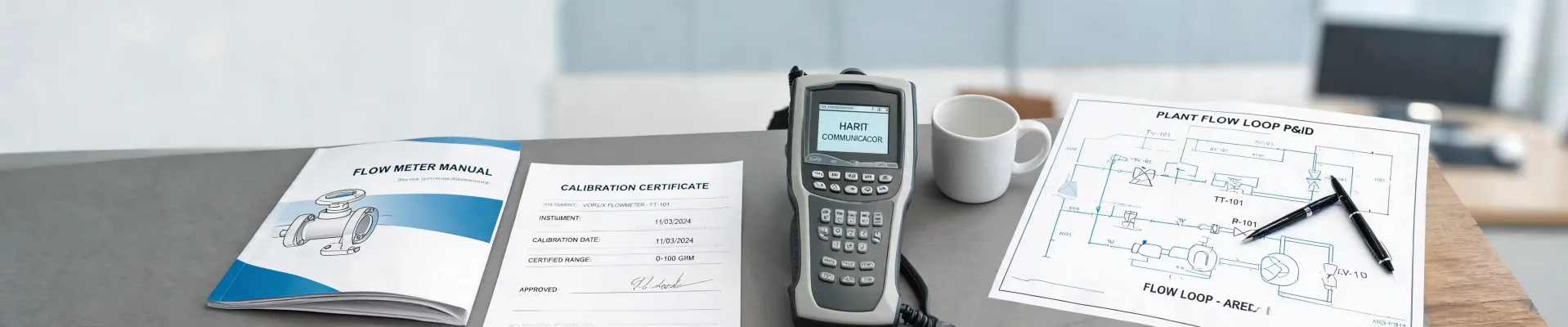
- Request the actual calibration certificate, not a generic one. Endress+Hauser provides individual certificates with serial numbers and measured values. Cross-check the 'as found' and 'as left' data. If they only give you a 'conformance statement,' that's a red flag.
- Look for hidden costs in the quote. The 'transparent pricing' vendor who lists everything upfront – shipping, packaging, documentation, even a small charge for the manual – is more trustworthy than the one who shows a low price and adds fees later. I've learned to ask 'what's NOT included?' before looking at the bottom line.
A note on thermal cameras and multimeters
While we're on the topic of verification tools, I sometimes use an infrared thermal camera (like the Flir IC thermal camera) to check if a flow meter's electronics enclosure is overheating – a common sign of internal issues. But I wish I had tracked the correlation between surface temperature and failure rate more systematically. Anecdotally, a case temperature above 55°C in a 35°C ambient suggests something's off. The Fluke 114 multimeter, on the other hand, is my daily companion for loop checks and resistance measurements. It's not a substitute for a full calibration bench, but for field verification it's more than adequate.
One more thing: if you're reading this and wondering 'how to read a Fluke multimeter' – it's simpler than you think. Set it to the right range (DC mA for 4-20 mA loops, DC V for PT100 RTD signals), connect in series or parallel appropriately, and read the display. But I'm getting off-topic. The point is: the tool is only as good as your procedure.
When this approach might not work
This worked for us – a mid-sized process plant with predictable order patterns and an in-house quality team. If you're a small startup buying one meter at a time, you may not have the luxury of rejecting batches or demanding custom documentation. In that case, I'd recommend sticking with a reputable supplier like Endress+Hauser and at least asking for a 'certificate of compliance' with the purchase order. Also, if you're dealing with hazardous area approvals (ATEX, IECEx), the verification steps multiply. I can only speak to general industrial applications.
Granted, this requires more upfront effort. But it saves time and money later – especially when you avoid the $22,000 redo like we did.
Per FTC advertising guidelines (ftc.gov), I should disclose that I have no financial relationship with Endress+Hauser or Fluke. All opinions are my own based on professional experience.

Jane Smith
I’m Jane Smith, a senior content writer with over 15 years of experience in the packaging and printing industry. I specialize in writing about the latest trends, technologies, and best practices in packaging design, sustainability, and printing techniques. My goal is to help businesses understand complex printing processes and design solutions that enhance both product packaging and brand visibility.