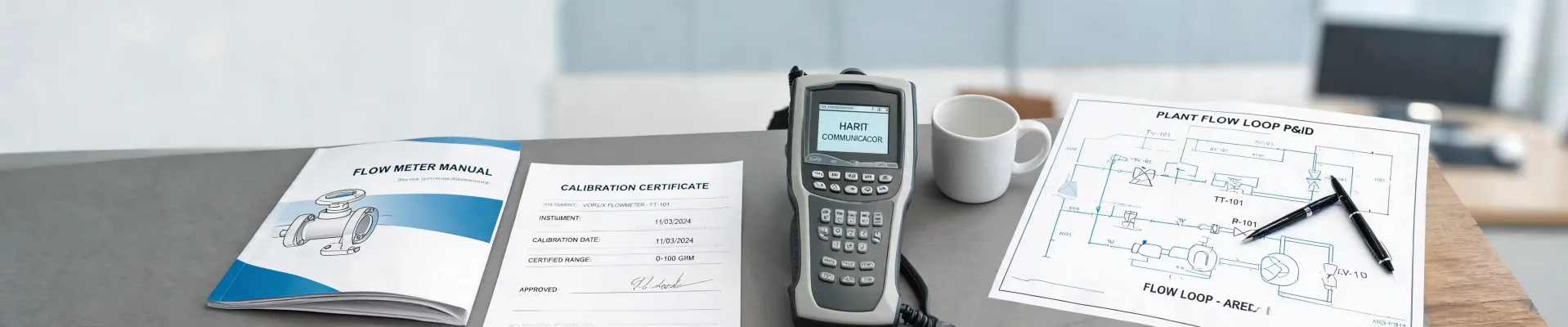
Technical article
Endress-Hauser App, Nuclear Level Transmitters, and Hand Tools: A 7-Step Buying Checklist
by Marcus Feld
A practical buying and usage checklist for plant teams: Endress-Hauser nuclear level transmitters, the Endress-Hauser app, 500-196-30 digital caliper reviews, multi channel pipettes, and Extech moisture meters.
-
Use This Checklist When...
-
Step 1: Define the operating environment before looking at brands
-
Step 2: Challenge the specialist default
-
Step 3: Set up the app before commissioning
-
Step 4: Say 'calibrated' and 'certified' separately
-
Step 5: Verify incoming measurements with an independent hand tool
-
Step 6: Respect the boundary of your expertise
-
Step 7: Track total cost, not sticker price
-
Common mistakes and last reminders
This checklist is for people who buy or specify measurement tools in a process plant. It is not a textbook. What I mean is: it is the routine I use as a procurement manager when a request comes in for anything from a $400 portable moisture meter to a plant-wide transmitter package.
I manage the purchase, not the engineering. After a few expensive lessons, I now work through seven steps before approving any instrument order. The same steps work for an Endress+Hauser level transmitter and for a simple handheld tool.
Use This Checklist When...
Use this when you are choosing a technology for the first time, replacing an old unit, or adding a tool to the maintenance kit. If you already have a working solution, skip the technology-step and still review calibration, app setup, and total cost.
Step 1: Define the operating environment before looking at brands
The biggest mistake I made was starting with a brand and working backward. Before you type 'nuclear level transmitter Endress-Hauser' into a search bar, write down what the process actually looks like.
- Pressure, temperature, and process connection
- Vessel geometry and agitator position
- Foaming, steam, dust, or coating build-up
- Hazardous area classification and safety requirements
For extreme pressure, temperature, or corrosive situations, a nuclear level transmitter Endress-Hauser (the Gammapilot family, in radiometric terms) may be the right option, because it sits outside the vessel. According to Endress+Hauser product documentation (endress.com, accessed January 2025), the Gammapilot FMG50 is a compact radiometric transmitter for level measurement. That detail matters because 'nuclear' sounds more alarming than 'radiometric,' but in practice it is a controlled application with licensing. Do not put it in the spec until you have a clear 'why'.
Step 2: Challenge the specialist default
A good vendor will sometimes say 'you don't need what I specialize in.' That happens more often than you think. In March 2023, a team asked us to replace a failed level system and assumed we needed another radiometric unit because the vessel was packed with an agitator. We called the vendor, walked through the application, and ended up with an Endress+Hauser Micropilot radar transmitter instead of a nuclear level transmitter. It worked, and we avoided the radioactive-source paperwork entirely.
That experience changed how I write tenders. Now every request includes a line: bidders may propose alternative technology if the standard spec does not fit the application. It is a step that costs us nothing and has saved us real money.
Step 3: Set up the app before commissioning
Once a device arrives, the fastest way to reduce installation errors is to configure it before you put the ladder up. For Endress+Hauser products, the Endress-Hauser app (SmartBlue) is worth setting up on your phone or tablet. As of January 2025, the app supports Bluetooth-enabled devices; check the current compatibility list on the manufacturer's download page before relying on it.
What do I do with it? I collect the serial number, tag number, calibration status, and first runtime reading. I also export the device config before the technician makes changes, so we have a restore point. That simple habit saved us a week of commissioning time on a project in Q4 2024.
Step 4: Say 'calibrated' and 'certified' separately
Early in my career, I ordered a transmitter and specified 'calibration before shipment.' The supplier did exactly that. A third-party evaluator later asked for an ISO 17025 certificate, and we could not provide one because the certificate was not in the purchase order. I said 'calibrated'; they heard 'factory-adjusted.' The difference mattered.
Now I put two lines in every order: one for calibration (device adjusted and tested) and one for certification (documented, traceable, and signed). This is especially important for portable instruments too. The common 'how to use Extech moisture meter' search will tell you about modes, but it should start with calibration: use the reference block if the meter has one, or test a known dry material first. The meter is only useful when you know its baseline.
Step 5: Verify incoming measurements with an independent hand tool
For dimensional work, the 500-196-30 digital caliper reviews led me to a solid tool. I read reviews for days, and the consistent theme was repeatability. That matters when your maintenance team uses one caliper to check a spare part against a drawing. We bought two units after our quality lead asked for SPC output, and they have held up through daily shop-floor use.
The key is not the brand; it is the mid-point check. Use a gauge block or known pin to verify the caliper before you take a critical reading. If the jaw shows wear, retire it. A caliper is a small-dollar decision that can prevent a big-dollar wrong purchase.
Step 6: Respect the boundary of your expertise
I can negotiate a transmitter contract, but I am not the person to specify a multi channel pipette. Our lab manager decides between an 8-channel and 12-channel pipette, which tip system fits, and whether the volumes need to be verified by gravimetric calibration. My job is to get quotes and include service. I ask one question: who calibrates it, and how long is the turnaround? Then I stay out of the technical decision.
That boundary is a feature, not a weakness. A vendor who says 'this isn't our strength, here is a specialist' is more credible than one who claims to be good at everything. I'd rather trust a specialist who knows their limits than a generalist who overpromises.
Step 7: Track total cost, not sticker price
After tracking six years of instrument purchases in a spreadsheet, I found that the biggest budget overruns—I could not tell you the exact percentage without pulling the file—came from things after the quote: expedited freight, missing calibration certificates, and training sessions we did not plan. That is why the approval sheet in our department now has a line for total cost of ownership. Include the transmitter, the app license, the cable, the spare parts, the calibration, and the documentation.
For a nuclear level transmitter Endress-Hauser application, add source handling, transport, safety planning, training, and disposal. Those are the line items that decide whether the specialty solution is actually economic. If the simple measurement technology works, it will almost always win on total cost. The numbers may point to the cheaper quote, but my gut checks the lead-time guarantee first.
Common mistakes and last reminders
- Ordering a 'standard' cable or sensor for a hazardous area without checking the certificate against the tag.
- Using an app to configure a device, then changing one setting and not saving the old configuration.
- Treating a pin-type moisture reading and a pinless scan as the same number. They are not; read the meter instructions.
- Forgetting that a multi channel pipette is a precision tool. If you drop it, it needs recalibration, not a guess.
- Evaluating a vendor only on price. The cheap quote that lacks calibration support usually costs more by the time you have to send the tool out.
Run this checklist before every instrument purchase. It will not make you a metrology expert—that is exactly the point. It keeps you from crossing the line into decisions where you should be asking a specialist.

Marcus Feld
Marcus Feld is an electrical test and measurement analyst specializing in multimeters, oscilloscopes, clamp meters, insulation testers, spectrum analyzers, and data loggers. He applies IEC 61010-2-030 and IEC 61010-031 concepts while examining measurement category, bandwidth, true-RMS response, input loading, and stated uncertainty. His work helps maintenance engineers and test teams choose safe instruments with performance suited to the signals and environments they actually measure.